
The Re/Cap Podcast: Harvard’s Peter Der Manuelian on 3D Pyramids of Giza, Ancient Egypt, Immersive Learning & Museums
FULL EPISODE
There are the singular thinkers. There are the exquisitely well-read. Then there are the rarified practitioners.
Dr. Peter Der Manuelian, somehow, has ascended to be all three.
He is Harvard's Barbara Bell Professor of Egyptology, Director of the Harvard Museum of the Ancient Near East, and the architect of The Giza 3D Project.
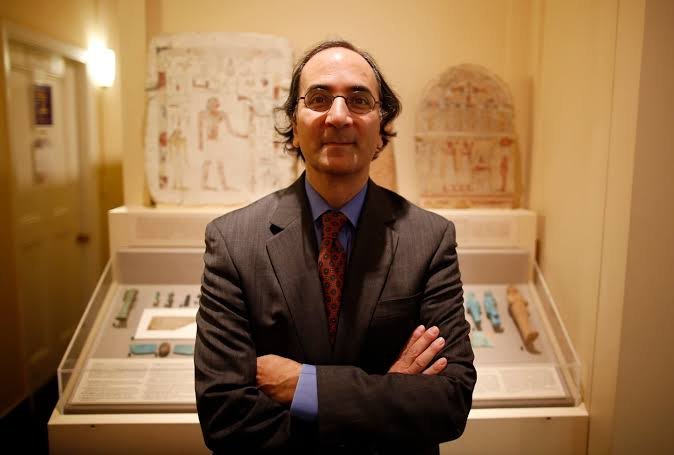
Dr. Peter Der Manuelian at the Harvard Museum of the Ancient Near East. Credit Boston Globe
This decades-long effort is digitally reconstructing one of humanity’s most storied landscapes, and placing it in the hands of anyone with a screen and a curiosity. He was generous enough to join Ellis Malmgren on The Re/Cap for a conversation ranging from sunlight geometry in 4,500-year-old tombs, AI-powered Arabic diaries, and drone regulations on the Giza Plateau, to what modern America can heed from Ancient Egypt and his take on the aliens-built-the-pyramids theory. Oh, and what the deal was with Ancient Egyptians loving cats!
Here's what stuck.
The 3D model revealed something the field missed for decades. One tomb on the east side of the Great Pyramid has a window that nobody paid much attention to; that is until Peter's team built a digital reconstruction and mapped the arc of sunlight streaming through it. The light shoots across the room and lands directly on the sacred offering niche. You cannot see this in a photograph. You cannot feel it in a field note. The model showed it. Peter now suspects other tombs were built the same way; intentional light design, engineered 4,500 years before anyone called it architecture.
He saw hieroglyphs on a screen before screens could render them. Walking through Harvard Square in the early 80s, Peter spotted the first Mac in a computer store window. The graphical interface hit him immediately: this is pictorial, and ancient Egypt is pictorial. That single intuition launched a career-long push to invite Egyptology into the digital age, a full decade before most of the field was willing to follow. He published his digital epigraphy workflow in the early 90s to near silence, then watched it become standard practice far later. Figures - the innovator and the adoption curve seldom arrive at the same time.
73 Arabic diary books spent decades sitting in a village in Upper Egypt. The Egyptian foremen, laborers, and field supervisors who actually excavated Giza left behind 6,500 pages of handwritten records that nobody had collected.
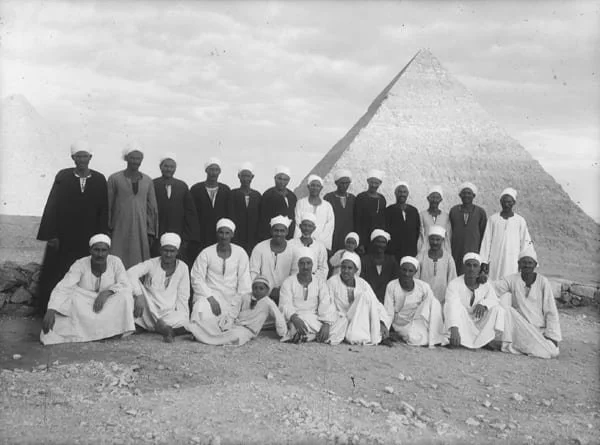
Peter spent years tracking down descendants of revered Egyptologist George Reisner's workers, asking questions, building relationships. Eventually someone pulled out a book filled with Arabic and sketches of Nubian pyramids. There were 73 more at his house. Peter raised the money, secured the permissions, and brought them to Boston. Now The Arabic Diaries Project, AI is now transcribing them at 96% accuracy. A century of erased voices is becoming searchable, translatable, and eventually fully integrated into the Giza Project as a living part of the archaeological record.
Drones over Giza are coming, just not yet. Peter wants to fly them systematically up and down the streets of the tomb complex, capturing everything in photogrammetric detail. Egypt requires foreign researchers to hire a specific Egyptian company and obtain Ministry of Tourism and Antiquities approval. Peter is fine with that, as the application is in the works. When it happens, it will be one of the most detailed aerial archaeological surveys ever conducted at the site.
The greatest threat to public understanding of ancient Egypt is persuasive fiction. Deep-fake graphics of enormous cylindrical chambers beneath Khafre's pyramid are circulating right now. No such project exists. Peter is spending real classroom time teaching students to identify this material, because it spreads faster than any correction, and because - as he puts it - it's somewhat insulting to the actual genius of the people who built these things without alien assistance.
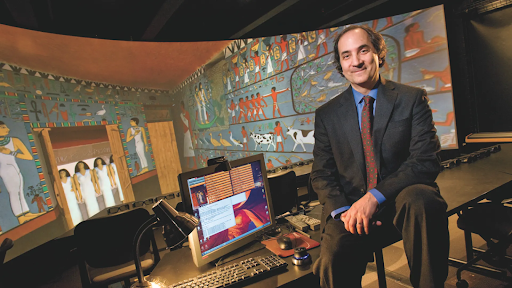
A civilization that endured for four millennia. A scholar who thinks in centuries.
Peter has been at this for 25 years. The Giza Project has been rebuilt from scratch multiple times as technology cycled into obsolescence beneath it. His answer to what excites him most about 2026 was, without hesitation, artificial intelligence; specifically its ability to manage archaeological data sets so vast that no human mind could hold them, and to surface research questions that nobody has thought to ask yet.
Enjoy a conversation that moves fast, traverses eras, and is worth every minute.
