
The Re/Cap Podcast: Caldwell Buntin, PhD on his Drone Dinosaur Discovery, Photogrammetry, Academic VR, Geology, Mars, De-Extinction
When ABC News and Smithsonian simultaneously pick up your story, you're either onto something truly groundbreaking or you've accidentally started a minor international incident.
In Dr. Caldwell Buntin's case? It was groundbreaking, but for for prehistoric incidents.
Packin’ a DJI Mini 2 and photogrammetry software, the Old Dominion University lecturer discovered evidence of dinosaur courtship behavior etched into 100-million-year-old sandstone at Colorado's Dinosaur Ridge. Not footprints. Not random geological happenstance. Courtship displays. As in: dinosaurs had game, and we can now prove it through aerial survey data.
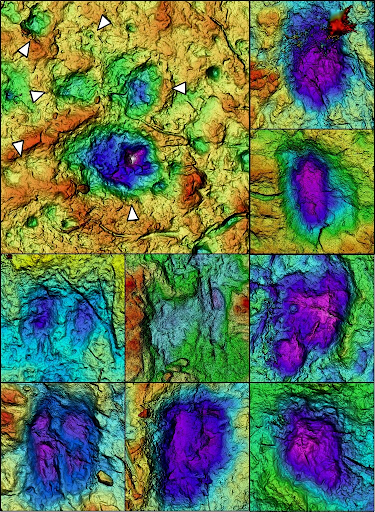
The "bowl-shaped" marks represent male male dinosaurs’ mating ritual to attract females. IF they’re skilled & lucky. Credit ABC News via Caldwell Buntin
Reality Capture Meets Deep Time
Dr. Buntin joined me on The Re/Cap Podcast to unpack how accessible technology is democratizing discovery itself, while showcasing what consumer drone capabilities. Buntin used Dronelink mission planning with 60% image overlap at 123 meters altitude. Six aerial surveys. Standard photogrammetric reconstruction. The kind of workflow that, a decade ago, would have required institutional funding and specialized equipment.
And yet here we are; consumer tech revealing behavioral patterns from the Cretaceous period.

Dr. Caldwell Buntin. Credit Old Dominion University
We dig into the nitty-gritty of the process; what drone data proved unusable, why surface degradation from millennia of weathering didn't torpedo the reconstruction, which processing software earned its keep, and crucially, what the data revealed that human eyes could not. Because that's the plot twist nobody sees coming: sometimes the technology shows you what was always there, hiding in plain sight.
An Oceanographer Walks Into a Paleontology Site...
Buntin's PhD is actually in oceanography. There’s a semantic reason - Old Dominion’s degree-naming procedurals. But it nonetheless makes his geological and paleontological fluency all the more intriguing. This cross-pollination is extensively explored; how skills transfer between domains, whether natural sciences are truly adopting 3D technology or just flirting, and where resistance to digital methods may actually be justified.
Spoiler: not all skepticism is Luddite territorialism. Some of it is honest caution about "mistaking the map for the territory," as the saying goes. We go there, while also exploring:
The Technical: Ground control points. Accuracy metrics. Why 60% overlap versus some other threshold. What makes Dronelink worthwhile versus a distraction.
The Scientific: The original paper. What could falsify the courtship interpretation? What else can we infer about these dinosaurs' size and behavior?
The Philosophical: Is science becoming democratized? What separates great researchers from merely good ones? How might AGI reshape natural sciences? And perhaps most provocatively: will de-extinction companies like Colossal Biosciences actually succeed, and should they?
The Personal: Which discipline is most ripe for technological augmentation? How much does an Earth scientist think about other planets? (And yes, we address that tantalizing abstract line about "potential life on other planets.")
Why This Matters
If you're reading this, you already understand that reality capture transcends buildings and infrastructure; it's truth retrieval, making the invisible visible, the inaccessible accessible, the unknowable knowable.
Buntin's work exemplifies this at a scale most of us never consider. He's using the same fundamental technologies you might deploy on a construction site or a heritage documentation project, except he's applying them to understand dino courtship rituals from 100 million years ago.
The implications ripple outward: What else are we missing? What other discoveries are sitting there, waiting for someone with a consumer drone and enough intellectual hunger to ask better questions?
Plus: Bio-Glue, Jurassic Park Takes, and NASA GIS
Because no conversation is complete without: the substance keeping those trackways from disintegrating further (bio-glue…yes, really), Buntin's verdict on whether Jurassic Park is properly rated, his GIS history working with NASA, and his magic-wand vision for improving peer review.
