
The Re/Cap Podcast: Gaussian Splatting, Why It’s Called That, and World Models
Services rendered today include rendering, as Ellis Malmgren Re/Caps how Gaussian splatting is integral to world models, what the heck those are to begin with, and the heated competition around them.
But first, ah, the age old debate - how to pronounce this mythical G-word, this means of splatting (“splatting,” by the way, comes from the sound a snowball makes upon being thrown at a brick wall. Yes, that is the analogy in the seminal 3DGS paper.).
Whadda we look like at RCN, linguists? You utter G-A-U-S-S-I-A-N however ya wanna. But, as for the etymology of it?
Guten Tag, Carl Friedrich Gauss.
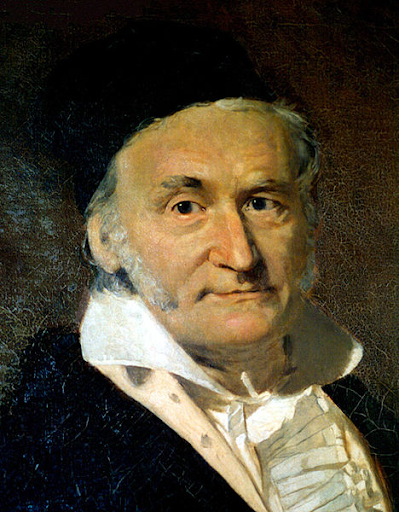
Carl Friedrich Gauss. Credit G. Biermann via OpenDSA
A Precocious Youth
Widely lionized as the Prince of Mathematics, this German wunderkind was blowing peeps away barely after ditching training wheels. His elementary school teacher was flabbergasted when Gauss instantly found the sum of the integers from 1 to 100. Gauss had realized that the numbers could be paired: 1 + 100, 2 + 99, and so on - making 50 pairs that each summed to 101, for a total of 5050. Then at age 15, when his peers were just outgrowing lederhosen and trying to land a date to 1792’s prom, Gauss made his first notable mathematical contribution by constructing a 17 sided polygon using only a ruler and a compass.
Then Gauss hit turbo mode: in his teens and twenties he proved the fundamental theorem of algebra, cracked quadratic reciprocity, and reinvented astronomy by predicting the orbit of the “lost” dwarf planet Ceres. Thanks to his geodetic survey of the Kingdom of Hanover, Gauss invented the heliotrope in 1818, a device that employs mirrors to reflect sunlight over long distances. He also pioneered the method of least squares - a way to fit messy real-world data to precise mathematical models. If that sounds familiar, it should: surveyors, scanners, and renderers today can still call on the same principle to tame noisy data.
Gauss Grows Up, Somehow Does Bigger Things
Pioneering a groundbreaking global magnetic survey, Gauss coordinated an international scientific effort to collect magnetic field data worldwide. By analyzing these measurements, he developed a mathematical model describing the Earth's magnetic field. That’s just a Tuesday for him; at 70 years old, which is like 213 today, he published a two-volume book on geodesy thanks to doing more work with triangulation than Phil Jackson.
Gauss solved so many global problems, my man was practically one UN badge away from peacekeeping duties. But how did he earn the namesake of this 21st-century, burgeoning 3D rendering methodology, the buzziest of conference buzzwords, Gaussian splatting? Welp, look back to his princehood - mathematics.
Gauss’s name lives on in the Gaussian function, the smooth bell-curve shape at the heart of what are called normal distributions. Modern splatting techniques use those same functions to turn discrete point samples into a continuous, believable scene. In 3D rendering, each “splat” is just a tiny Gaussian blob, helping blend millions of points into coherent geometry, and immaculate recreations - Gauss’s math reborn in rendering.
Carl Friedrich Gauss made good guesses, great inventions, and bewildering computations. So of course he reached I-belong-on-currency status. Penny for your thoughts, 10 Deutsche marks for your math.
Gaussian Splatting and World Models
Today, Gauss would surely grant his imprimatur to the stunning innovation for which his namesake’s splatting is crucial - the world model. And as the European tech news outlet 36KR explained, there is quite the battle royale for which venture will be the model, for world models.
But before we throw down, let's level-set: what is a world model?
Think of it like this - if AI is gonna interact with reality, it needs a mental playground first. A world model is basically AI's internal simulation of how the world works. It's the difference between a chess engine that knows "knight moves in an L" versus one that can predict where your knight may just be three turns from now.
For robots, or embodied AI that needs to navigate, manipulate, and exist in physical space? Essential. A world model lets AI reason about consequences before acting - "if I push this, what happens?" - without breaking grandma’s vase first.
Some world models focus on making things look real. Others focus on making things behave real. That distinction? That's the whole ballgame. So, as for this world-model-building fracas.
In one corner: Fei-Fei Li, godmother of ImageNet, dropping Marble through her startup World Labs. Marble generates persistent, downloadable 3D environments that export as Gaussian splats, meshes, or straight-up videos. It's got Chisel, a built-in AI world editor where one prompt gets you a whole 3D universe, exportable to Unity with a click. Game devs? VR peeps? This is your fast pass.
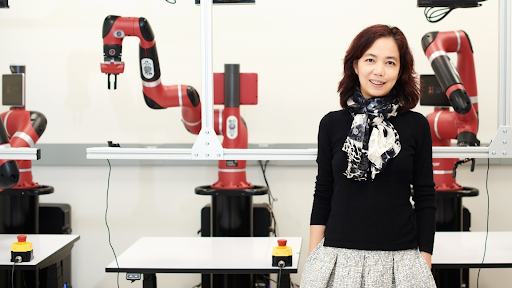
Fei-Fei Li. Credit Yale University
But here's the rub: critics say Marble's more of a 3D rendering model than a true "world model". It's gorgeous, sure - thousands of those fuzzy Gaussian bubbles splatting together into translucent, halo-surrounded visual poetry. But it captures surface appearance without the underlying physics of "why the world operates in XYZ manner." A ball on a slope? Humans see it roll. Robots need mass, friction, velocity - data that doesn't quite exist in Marble. It's a front-end asset generator, killer for commerce, maybe slightly less killer for training the next Optimus Prime. But be warned, doubting Fei-Fei Li is like doubting peak Tiger Woods on a nursing home putting green.
In the opposite corner: Yann LeCun, peacing out from Meta as Zuck’s chief AI scientist, prepping his own world model venture - JEPA, for Joint Embedding Predictive Architecture.
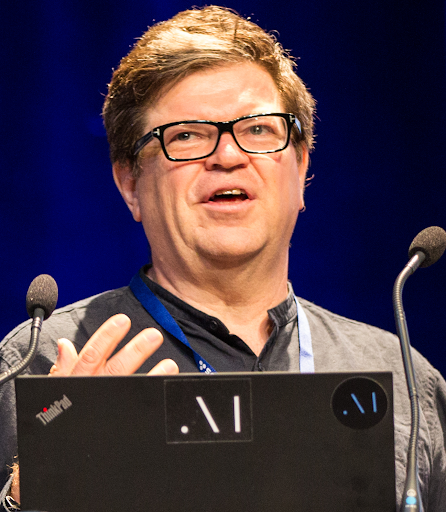
Yann LeCun. Credit Wikiquote
LeCun's approach isn't rooted in 3D graphics, but in control theory and cognitive science. You can't even see this world model - no pretty pixels, no export button. JEPA focuses on abstract representations that enable robots to predict changes and think several steps ahead before acting. It's training the robot's brain. Call it the back-end prediction system - less drool-worthy resplendence in demos, more raw fundamentals for AGI.
Lurking between these titans is Google DeepMind's Genie 3, which generates interactive video environments where users can explore for minutes, with long-term consistency and triggerable events like rain or nightfall. It's a world-model-style video generator - it makes the world move, but its core is still video logic, not physics-and-causality-based like JEPA.
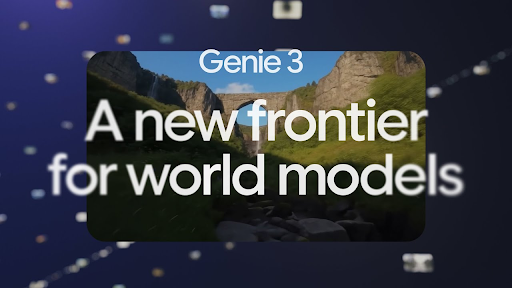
World Model Rundown
Marble renders "what the world looks like," JEPA explores "what the structure of the world is,” and Genie 3 shows "how the world changes.” Three paths, three philosophies, one pyramid - with the most abstract, robot-ready models at the top, and the most human-friendly, visually stunning ones at the base.
World models might just be a proving ground where the future of AGI is decided. And we know who’d be thrilled to spectate - Carl Friedrich Gauss, who spent a lifetime teaching us how to describe the world mathematically. Now the question is: which math makes the best world? Stay tuned
